
Cotton Fabric Shrinkage: How Much to Expect, How to Test It and What to Allow
Also called: residual shrinkage, fabric shrinkage, pre-shrunk cotton
Updated · By Srihari Bang
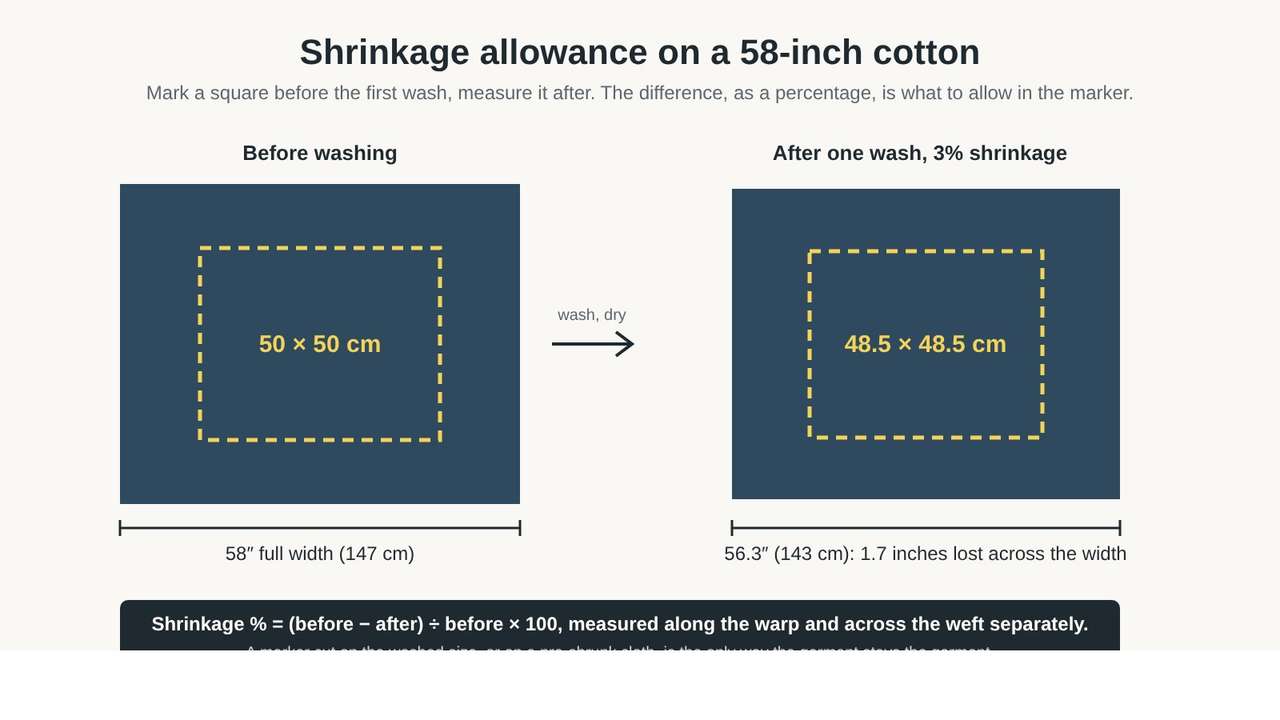
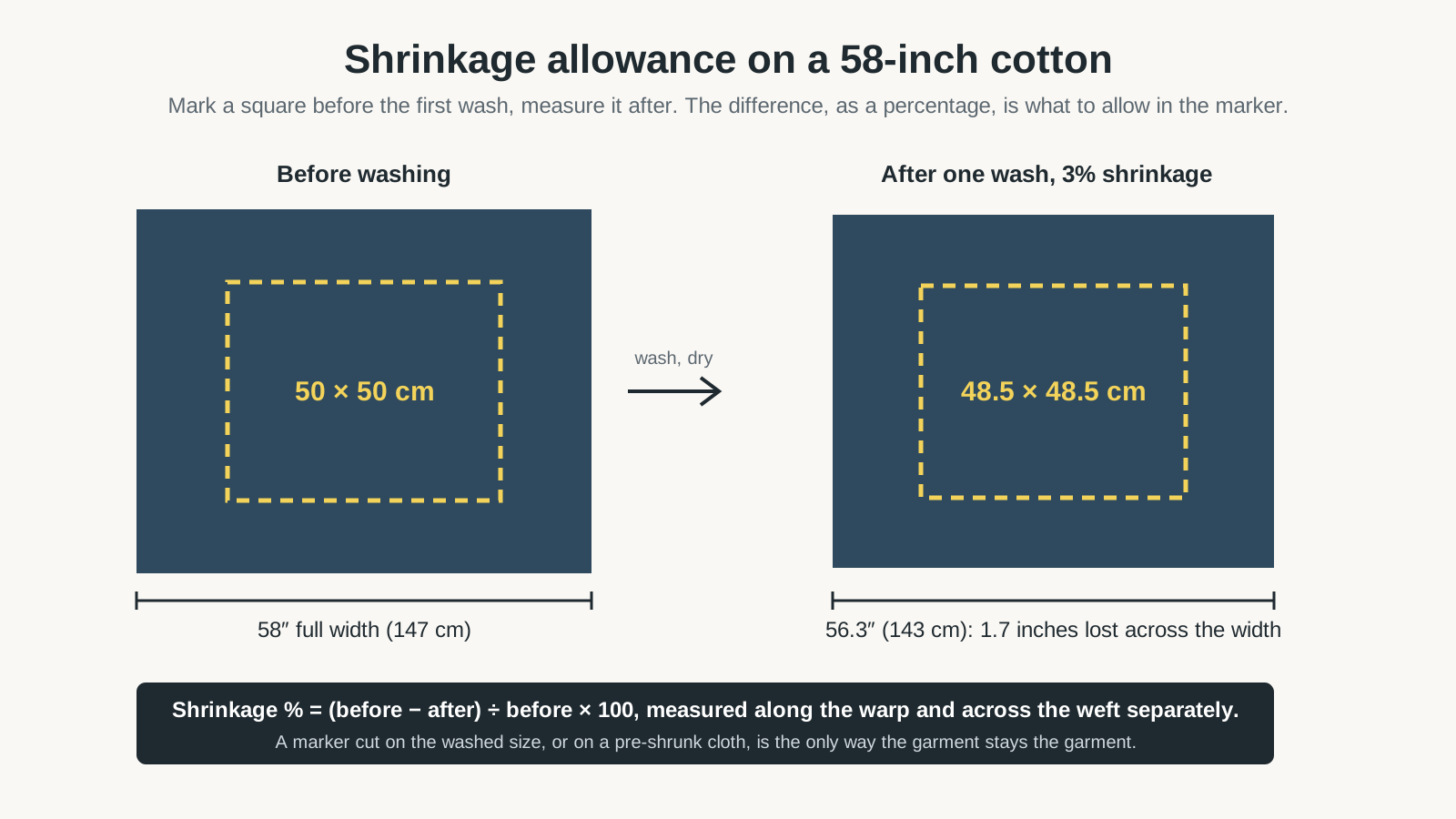
Fabric shrinkage is the loss of length or width a cloth shows after washing, stated as a percentage of its size before washing, and measured along the warp and the weft separately.
Woven cotton shrinks mostly on the first wash, because the yarns relax from the tension of weaving and finishing. Measure it by marking a square on the cloth, washing it and measuring again. Cut the marker on the washed size, or buy a pre-shrunk cloth, whose residual shrinkage is held under one per cent.
Key facts
| What shrinks | Length (warp) and width (weft), by different amounts |
|---|---|
| When | Mostly on the first wash; smaller amounts on the next few |
| How to measure | Mark a square, wash, re-measure; shrinkage % = (before − after) ÷ before × 100 |
| Pre-shrunk (sanforized) cloth | Residual shrinkage held to about 1% or less |
| Worked example | A 57–58 in cloth at 3% shrinkage loses about 1.7 in of width |
What is fabric shrinkage?
Shrinkage is how much smaller a cloth becomes after washing, given as a percentage of its size before washing. It is measured in two directions, along the warp for length and across the weft for width, and the two figures are usually different. A specification that gives one shrinkage figure is giving the larger of the two, or an average, so ask which.
Why does cotton shrink?
Cotton yarn is pulled straight and held under tension while it is spun, woven and finished, and the cloth leaves the mill slightly stretched. In water the fibres swell and the yarns relax into a shorter, more crimped path. That relaxation is most of the shrinkage, and it happens on the first wash. Later washes add smaller amounts as the fabric settles, which is why a shrinkage figure is quoted after a stated number of washes.
How is shrinkage measured?
Lay the cloth flat and draw a square on it, 50 by 50 cm, with one side along the warp. Wash and dry it the way the finished garment will be washed, then lay it flat again and measure the square. Shrinkage in each direction is the loss divided by the original 50 cm, times 100. A square that comes back at 48.5 cm along the warp and 49 cm across the weft has shrunk 3% in length and 2% in width.
Sanforized and other pre-shrunk finishes
Sanforizing is a mechanical finish that compresses the cloth lengthways between a rubber belt and a heated cylinder before it is sold, so the relaxation that washing would cause has already happened. A sanforized cloth is designed to show a residual shrinkage of about one per cent or less. Other pre-shrinking routes, such as washing the cloth at the mill, aim at the same result by a different method. The finish line on our product pages and swatch cards says what the cloth had, and the shrinkage figure is the number to ask for alongside it.
How much should you allow when cutting?
Take the shrinkage figures for the cloth you are cutting and add them to the pattern in each direction, or cut on a cloth that has already been pre-shrunk. On our 57 to 58 inch Piece Dyed Texture Dobby 9072G, 3% shrinkage across the weft takes about 1.7 inches off the width, which changes how many pattern pieces fit across a marker. Measure a sample from the actual roll, because two cottons with the same count and construction can shrink differently if their finishes differ. How to read the finish and the other lines on a specification is covered in how to read a woven fabric specification.
Frequently asked questions
Why does cotton shrink when it is washed?
Weaving and finishing stretch the yarns and hold them under tension. Water lets the fibres swell and the yarns relax back to a shorter, fuller shape, so the cloth gets a little smaller in both directions.
How do I test shrinkage myself?
Draw a 50 by 50 cm square on the cloth in warp and weft, wash and dry it the way the garment will be washed, lay it flat and measure the square again. Work out the percentage for each direction separately.
Does a sanforized fabric shrink at all?
A little. Sanforizing is a mechanical pre-shrinking process that compresses the cloth before it is sold, and it is designed to leave a residual shrinkage of about one per cent or less, so a garment keeps its size.
How much shrinkage should I allow in the pattern?
Whatever the test shows for that cloth, in each direction. Measure a sample from the roll you will cut, because two cottons with the same specification can shrink differently depending on their finish.
Sources
- Shrinkage (fabric), Wikipedia (opens in a new tab) (read 2026-10-19)
- Sanforization, Wikipedia (opens in a new tab) (read 2026-10-19)
Srihari Bang, Managing Director. Srihari Bang has been Managing Director of Bang Textiles & Clothing Pvt Ltd in Bengaluru since June 2023, after four years in new business development at Bang Polypacks in Mumbai. He studied family business management at SP Jain School of Global Management and holds a bachelor's degree from Christ University, Bangalore.
Looking for this fabric? Send an enquiry or browse the fabric catalogue.